
user profile

Last Updated : Aug 06 2025

Lula Commerce
Lula Commerce

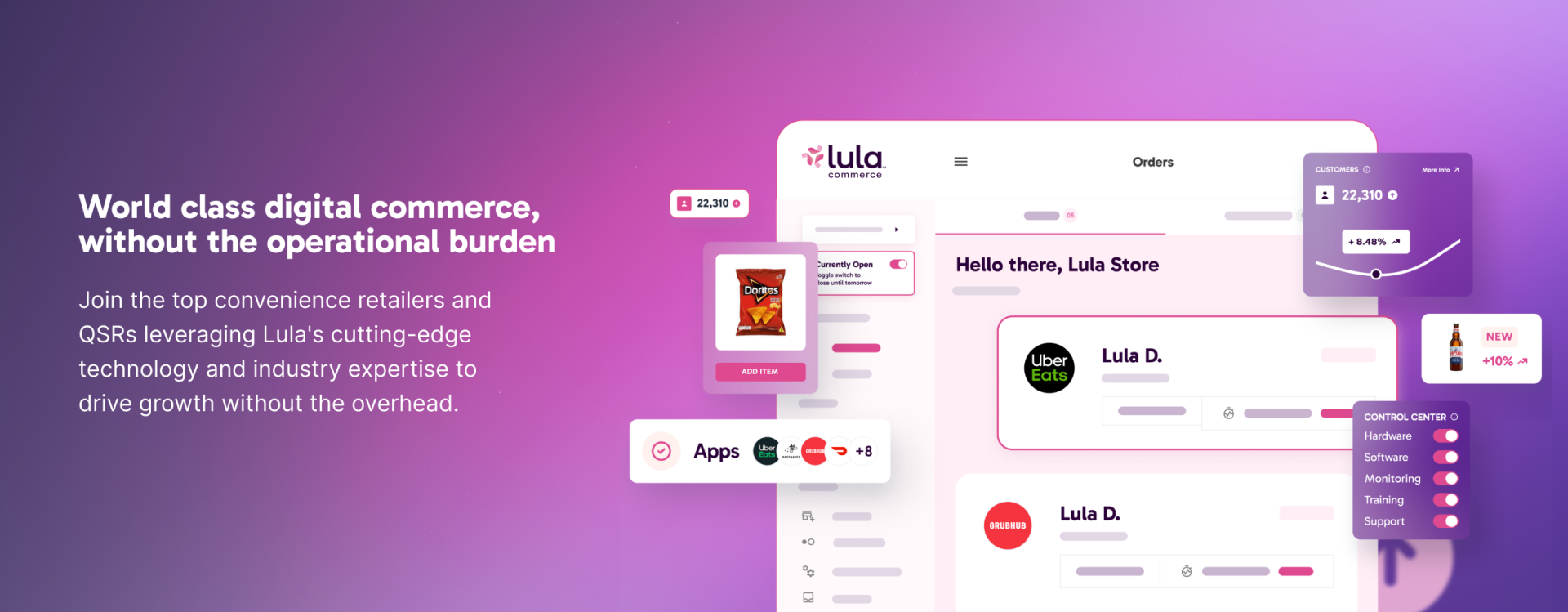
Lula is Shopify for Physical Retail: one API & toolkit that lets convenience and specialty stores launch and grow e-commerce in days, not months.

  • Enterprise
  • Opportunity

Lula Commerce gives independent convenience stores, gas stations, liquor shops, and pharmacies the same digital firepower as big-box chains. Our all-in-one platform—spanning real-time inventory, omnichannel ordering, customer engagement, and business intelligence—lets neighborhood retailers deliver a Domino’s-style experience across marketplaces, their own site, and even by phone. GoPuff proved that consumers want CPG products in under 30 minutes; we ensure that revenue flows back to local communities by providing the infrastructure small retailers need to capture their share of the multi-billion-dollar on-demand market.
Business profile
Primary contact
Adit Gupta
Country of incorporation
United States
Headquarters
Philadelphia, New Jersey, United States
Type of entity
C Corporation
Beneficiaries
Under-served retail stores, often immigrant owned busiensses
Launch year
2020
Team size
1-10
Sectors & themes
Financial services, Financial inclusion, Infrastructure, Resilient infrastructure, Other, Real estate
Target regions
North America
Business highlights
  • Grew from 300 to 1,500 stores in just 14 months across 35+ U.S. states.
  • Helps nearly 700 independent stores make money online (some 50+ year businesses) through Lula.
  • Platform-driven sales increased from $3M to over $20M within the last 6 months (reaching $1.7M ARR).
  • Exceptional product retention, evidenced by a Net Revenue Retention (NRR) exceeding 115%.
  • Achieve to EBITA-Neutral by Q4 2025.
  • Aiming to get to $3M in top-line revenue by end of 2025.
Sustainable Development Goals
 Decent Work and Economic Growth
Goal 8

Promote sustained, inclusive and sustainable economic growth, full and productive employment and decent work for all
 Industry, Innovation, and Infrastructure
Goal 9

Build resilient infrastructure, promote inclusive and sustainable industrialization and foster innovation

 Reducing Inequalities
Goal 10

Reduce inequality within and among countries
 Sustainable Cities and Communities
Goal 11

Make cities and human settlements inclusive, safe, resilient and sustainable

  • Problem
  • Solution
  • Product / service
  • Projected impact
  • Traction
  • Investors
  • Business model
  • Market & competition
  • Vision & strategy

Problem

Everyday retail chains juggle 20 + delivery apps, POS systems, and siloed data with no single source of truth. Manual updates cause wrong inventory, lost orders, and razor-thin margins—making it impossible to match 7-Eleven-level convenience. Lula unifies inventory, marketplaces, and AI growth tools so stores can launch omnichannel e-commerce in days, not months.

Solution

Lula is the eCommerce backbone for retailers, integrating their existing legacy systems into our intelligent hub. This connection instantly enables stores to sell through popular marketplaces (Uber Eats, DoorDash), branded direct-ordering channels (apps, web), and more. While retailers like 7-Eleven and Casey’s spent over 10 years building multimillion-dollar omnichannel operations, Lula empowers leading brands such as Jacksons Food Stores and Circle K to achieve comparable results in mere days—without additional headcount or operational complexity.

Product / service

Lula Hub (live): Digitizes inventory and connects to 23+ marketplaces with unified reporting.

Lula AI Operators (live): Autonomous agents that automate syncing, refund processing, and more, saving staff time.

Lula Direct (live): Web/app ordering (Q2’25) for higher-margin direct sales and loyalty.

Lula Voice (in R&D): Voice-activated ordering & support.

Lula Scan & Go (POC): Future self-checkout for in-store mobile payments.

Projected impact

Lula Commerce directly advances four UN Sustainable Development Goals:

  • SDG 8 – Decent Work & Economic Growth: By giving independent convenience stores, gas stations, and pharmacies a turnkey digital-commerce channel, we lift margins on core SKUs by 5-10pp and unlock incremental delivery revenue—preserving thousands of Main-Street jobs and enabling owners (often immigrant or family-run) to reinvest in wages, training, and local hiring.

  • SDG 9 – Industry, Innovation & Infrastructure: Our cloud-based “operating system for Everyday Retail” modernizes a fragmented sector that still runs on fax machines and paper price books. Lula integrates legacy POS hardware with AI-driven inventory, ordering, and last-mile logistics, creating a digitally connected micro-infrastructure that small businesses could never build alone.

  • SDG 10 – Reduced Inequalities: E-commerce tools are typically priced and architected for large chains; Lula levels the playing field. We subsidize hardware, offer usage-based pricing, and deploy multilingual AI agents so under-resourced merchants—in both rural food deserts and dense urban corridors—can compete on equal footing with big-box retailers.

  • SDG 11 – Sustainable Cities & Communities: Hyper-local fulfillment from neighborhood stores shrinks “delivery miles” versus centralized warehouses, cutting CO₂ per order while keeping sales tax and spending within the community. By helping stores stay viable, we maintain walkable, service-rich neighborhoods and prevent the blight that follows small-business closures.

Together, these impacts compound: stronger stores mean stronger streets, fairer access to essential goods, and a resilient local economy that can thrive in a digital-first future.

Theory of change

Theory of Change

Root problem
Independent convenience stores, gas stations, and pharmacies—often immigrant- and family-owned—operate on razor-thin margins and legacy tools. When consumer demand shifts to app-based, rapid delivery, these businesses lack the digital infrastructure to compete, resulting in closures, job loss, and declining neighborhood vitality.

Inputs & activities
Lula invests capital, cloud infrastructure, and AI talent to build an “operating system for Everyday Retail.” We (1) integrate with legacy POS systems, (2) activate omnichannel ordering and last-mile delivery, and (3) layer on AI agents that automate pricing, promotions, and customer support. We also provide micro-loans for hardware and multilingual onboarding to lower adoption barriers.

Outputs
Within 60 days of onboarding, a store gains:

  • Live listings across 3+ delivery marketplaces and its own white-label site

  • Real-time inventory sync covering >90 % of SKUs

  • Automated marketing campaigns and AI customer chat

Short-term outcomes (6–12 months)

  • 20–40 % lift in topline sales and 5–10 pp improvement in gross margin per SKU

  • Retention of existing staff plus incremental hiring for order pick/pack

  • Digital literacy gains for owners and employees

Long-term impact (3–5 years)

  • Resilient Main-Street economies that keep local tax dollars circulating (SDG 8)

  • A decentralized, tech-enabled retail infrastructure that reduces delivery miles and emissions (SDG 9 & 11)

  • A level playing field where small, diverse retailers capture fair market share of e-commerce spend (SDG 10)

By turning underserved shops into profitable digital hubs, Lula helps communities thrive while advancing equitable growth and sustainable urban ecosystems.

Traction

  • Explosive store growth
    • Expanded from 300 to 1,650 stores in 14 months—a 5.5× increase—now live in 35+ U.S. states and adding ~120 new locations every month.
    • Signed multi-unit pilots with Circle K, Jacksons Food Stores, and Hunt Brothers Pizza franchisees, putting another 3,200+ stores in the near-term pipeline.
  • Rapid GMV and revenue acceleration
    • Platform-driven sales surged from $3 M to $20 M GMV in the last six months. 
    • $1.7 M ARR today, up 4x year-over-year, with 172 locations on a revenue-share model generating an average 4.14 % take rate.

  • Deep customer stickiness & wallet expansion
    • Net Revenue Retention >115 % and logo retention >97 % across all cohorts.
    • 65 % of live stores use at least two Lula modules; 30 % use three or more, driving a 42 % ARPU lift within the first nine months of adoption.

  • Operational efficiency & AI leverage
    • Automated onboarding cut time-to-launch from 15 days to 3; digital order error rate fell below 0.3 %.
    • AI “Lula Operators” now resolve 80% of support tickets autonomously and have trimmed average ticket resolution time by 68%.

  • Tangible store-level impact
    • Partner stores see a 20-40 % boost in topline sales and 5–10 pp margin improvement within six months.
    • Typical location fulfills 40+ incremental digital orders per month, keeping local dollars—and jobs—in the community.

  • Clear path to scale
    • Self-serve onboarding beta shows a 30% conversion from inquiry to paid customer without human intervention.
    • Localized versions of the platform are in late-stage testing for Canada and the U.K., setting the stage for our first international rollouts in 2026.

These metrics confirm not just rapid top-line growth, but durable retention, expanding share of wallet, and a scalable operating model—all of which position Lula to become the default digital ordering backbone for everyday retail.

Investors

Profile Image Name Organization Investor Type Funding Amount Date
SOSV
Outlander Ventures
Up Partners
Broad Street Angels
Plug and Play
Up partners
Alumni Ventures USD
University of Pennsylvania USD

Business model

Lula’s revenue engine combines predictable SaaS subscriptions with high-margin transaction fees across two flagship products. Lula Direct powers a store’s own digital storefront—web, mobile, voice, kiosk, and in-store payments—priced at $49–$99 per location per month, plus a 1% fee on every first-party order. Lula Hub syndicates that same inventory to third-party marketplaces, handles routing, and reconciles payments; it commands a $39–$79 monthly fee and a 2 % share of marketplace GMV. Together, these streams yield a blended 3 % take rate on all transaction volume while anchoring stable SaaS revenue. The model is already delivering an average revenue per user of $68 per site, with meaningful upside as stores adopt additional modules. Thanks to self-serve onboarding and AI-driven support, our fully loaded customer-acquisition cost is recouped in five months, creating a capital-efficient growth loop where expanding GMV, rising ARPU, and quick payback compound to drive durable profitability. 

Market & competition

Everyday retail—convenience stores, gas-station marts, dollar outlets, drugstores, and specialty quick-turn shops—moves more than $700 billion in annual merchandise across North America, yet less than 6 % of those sales are transacted digitally. Post-pandemic consumer behaviour (sub-30-minute delivery, curb-side pickup, voice re-ordering) is pushing that penetration toward restaurant-like levels (~30 % digital), creating a multi-billion-dollar whitespace. We are starting in the U.S. and Canada, where there are ≈76 000 multi-unit chains with 10+ locations—our core ICP that already budgets for tech and can roll out regionally. Beyond that, the service-addressable market encompasses ≈550 000 individual stores (chains + independents) that could adopt at least one Lula module, while the global opportunity rises to ≈2.6 million small-format retail outlets across Europe, LatAm, the Middle East, and Asia-Pacific.

Competitive set

  1. Vertical marketplaces (GoPuff, Instacart, DoorDash Retail). Great consumer reach but charge high commissions, withhold customer data, and don’t offer first-party tools—eroding retailer margins and loyalty.

  2. Restaurant-first order aggregators (Olo, Deliverect, ItsaCheckmate). Strong order-routing tech, but road-mapped for menus and meal tickets; they lack inventory logic, age-restricted compliance, and C-store workflows.

  3. Legacy POS / ERP suites (NCR, Oracle, Lightspeed, Square). Deep in-store functionality, yet online-ordering add-ons are clunky, marketplace integrations shallow, and AI automation almost nonexistent.

  4. White-label commerce platforms (Mercatus, Swiftly, Stor.ai). Target large grocers with six-figure contracts; their heavy, grocery-centric feature sets and high implementation costs leave SMB retailers underserved.

Why Lula wins

  • Segment focus: Purpose-built for SKUs that “fit in a backpack,” with native handling of tobacco, alcohol, and age-verification—a gap for restaurant and grocery systems.

  • Dual-channel economics: Single platform spans first-party storefronts and third-party marketplaces, letting stores capture higher-margin direct orders while still surfing marketplace demand.

  • Plug-and-play tech: Lightweight APIs snap into legacy POS hardware in days, not months, avoiding rip-and-replace capex.

  • AI automation: “Lula Operators” act as digital staff—adjusting pricing, syncing inventory, answering chats—delivering big-box sophistication without big-box budgets.

As digital share races upward, everyday retailers have to choose between ceding traffic to marketplaces or owning their own omnichannel experience. Lula is the only platform that lets them do both—profitably—turning a vast, fragmented market into a defensible, high-growth opportunity.

Vision & strategy

Lula’s long-term vision is to become the universal digital-ordering backbone for anything you can grab, pocket, or carry—across every channel, category, and continent. Over the next decade we will power 100,000+ retailers and service providers with a suite of platforms that let consumers order however they want (voice, text, kiosk, smart-home, car dash, or a store’s own branded app) and receive goods wherever they are—in under 30 minutes, sustainably.

To realize this vision, we are executing on four strategic pillars:

  1. Omnichannel Access
    Build modular ordering interfaces—voice assistants, chatbots, direct web, in-store kiosks, and API hooks for emerging form factors—so any consumer interaction can convert into a sale without friction.

  2. Category Expansion
    Extend beyond traditional convenience into pharmacy, pet care, beauty, electronics accessories, office supplies, and fresh-prepared foods—essentially any high-velocity item that fits in a backpack or small delivery bag.

  3. Global Footprint
    Localize our platform for multiple languages, tax regimes, and payment rails, allowing us to launch in new countries with minimal engineering lift while empowering local fleets and gig-economy couriers.

  4. Intelligent Fulfillment & Growth
    Layer AI agents that optimize pricing, promotions, and inventory across channels while routing orders through the fastest, greenest last-mile option—whether bike, scooter, EV, or autonomous robot.

By knitting these pillars together, Lula will give independent retailers everywhere the digital superpowers once reserved for global giants—driving profitable growth, resilient local economies, and a more equitable, on-demand future.

Leadership
Our story
Think of the corner shop that knows your favorite snack, the gas-station clerk who greets you by name, the neighborhood pharmacy that stays open late so parents can grab fever medicine at midnight. These places hold communities together, yet, in a world where a tap on a phone decides where dollars flow, they’re fighting with one hand tied behind their backs. Lula exists to change that.

We’re building the operating system for Everyday Retail: the technology, data, and expertise that let a family-run bodega in Queens or a regional chain in Phoenix offer the same seamless, sub-30-minute experience as the biggest e-commerce giants. By weaving modern ordering, real-time inventory, and AI-powered support directly into the legacy tools they already use, we turn what was once a digital divide into a springboard for growth. Stores no longer need five expensive vendors or a team of data scientists; Lula delivers a single platform that amplifies their hustle and restores precious margins to the small businesses that keep local economies alive.

The impact is immediate and compounding. Local dollars stay local, circulating through wages, taxes, and community programs instead of disappearing into distant warehouses. Independent retailers, often immigrant-, minority-, or family-owned, gain the resilience to withstand economic shocks and the leverage to negotiate fairer terms with suppliers. Customers get faster, greener fulfillment because the products are already a few blocks away. And neighborhoods keep their character: vibrant, walkable streets anchored by stores that know and serve their people.

The mission is deeply personal. Adit’s parents ran a small convenience store in Voorhees, New Jersey for nearly two decades, serving neighbors through hurricanes, recessions, and late-night cravings. Yet in 2020, when lockdowns accelerated the shift to app-based shopping, the store’s razor-thin margins couldn’t absorb the sudden drop in foot traffic. Without a digital sales channel, they closed their doors for good. Watching his family’s livelihood disappear crystallized the stakes: if local retailers can’t access new, higher-margin revenue streams, entire communities lose their backbone. Lula exists to prevent that outcome, arming every store with an additional, profitable sales channel so they can not only survive, but thrive, in a digital-first world. 

We'd love to talk with you

 
Testimonials

Contact
Website
https://www.lulacommerce.com
Email address
adit@lulacommerce.com
Telephone
8565341534
Address
3230 Market Street, Philadelphia, New Jersey, 19104, United States
Country
United States
LinkedIn
https://www.linkedin.com/company/lula-commerce/
Facebook
https://www.linkedin.com/company/lula-commerce/

Join OptImpact

Join OptImpact to learn more about this enterprise and discover other opportunities.

Email:
Location:
Phone:

Biography

Get Full Access

Log in or sign up to access full details of this investment opportunity, explore all network content, and connect with other members of the community.

Login Sign up
Learn more about OptImpact
Help articles
  • How to request access to a diligence process underway?
  • What does closing diligence mean?
  • How do I customize templates?
  • What if I don’t want to use these templates?
  • How can I control who sees my templates?
  • How do I signal investment commitment?
  • How do I invite other people to the 'deal table'?

How to request access to a diligence process underway

Investor users can see, where peer investors allow, when a diligence process is underway or completed. When this is the case, users may contact the organization who leads the diligence process directly, or specifically request access to the diligence process underway in the event that those leading may be keen to include prospective coinvestors or collaborators. This ‘request’ functionality is visible only to investors.

Third parties or other user types may be invited directly to a diligence process by a lead investor by clicking on the “Invite” button on the Diligence tab. Once they accept, these users will have access to the diligence process including a shared Q&A area, a document repository, and a diligence-specific chat area.

What does closing diligence mean

Closing diligence means that an appraisal process led by a prospective investor of an organization seeking debt, grant or equity has been terminated. This may or may not mean that a diligence has effectively been completed; an investor may close said process at any time without further notification of next steps. This effectively closes the Diligence ‘table’ that has been opened and managed by a lead prospective investor. This also closes the process for any other investors or invitees to the ‘diligence table’, regardless of where they have been in the process.

How do I customize templates

In order to customize templates, a Master Administrator can go to the Diligence menu item on the left hand menu of the dashboard, and select ‘templates’. From there, one can either select an existing template from the dropdown under “Select template” or create a new one by clicking on the green “Create” button. All sub-questions in any template may be edited or deleted at any time.

What if I don’t want to use these templates

One does not have to use system templates if they are not helpful, applicable, or practical for user purposes. Simply upload whatever documents you’d like to ‘hold’ on the system and use the messaging tab to communicate with those at the virtual diligence table.

How can I control who sees my templates

Anyone who is invited into the diligence deal room for prospective co-investment alongside your own would be able to see the substance and structure of the templates you have constructed and applied to the diligence Q&A process on the Q&A tab. If you have not applied one of your templates, then others at the deal table will not be able to see it.

It is also worth noting that other team members that you have specified as part of your organization’s team will also be able to see the diligence templates that you have customized, if any.

How do I signal investment commitment

The platform is designed to be as flexible as possible in terms of process. As soon as an investor initiates diligence by clicking on the “Start diligence” button, it is possible from that point onwards at any moment to signal an investment commitment of any kind by clicking on the “Make investment” button at the top right of the Diligence tab. Investments can take the following forms: equity, debt, flexible, grant, equity/debt, equity/grant, convertible or blended - and the investor will be prompted to enter an indicative amount. It’s important to note that this is for signalling purposes only, and is a non-binding commitment.

Any figure entered here will be signaled as committed on the deal profile, and those inside the diligence deal room with the investor will see that he/she has signaled such a commitment; at the same time, a notification will be sent to the prospective recipient organization being reviewed. All binding legal commitments and money transfers happen offline and on the back of completion of proper documentation, for which the platform takes no responsibility. Investors contacts connected to you will not see that you have made this commitment.

How do I invite other people to the 'deal table'

Once Diligence has been initiated by an investor, one can click on the Diligence tab under Opportunity and immediately expand the virtual ‘deal table’ by clicking on “Invite organization”. One can search for different types of organization or by name, and will be required to consent to specific ‘terms of service’ related to sharing knowledge about an opportunity.

  • About OptImpact
  • Homepage
  • About us
  • Contact us
  • Legal Information
  • Terms and Conditions of Use

© Copyright 2025 Artha Networks. All rights reserved.

Artha is not a registered broker-dealer and does not offer investment advice or advise on the raising of capital through securities offerings. Artha does not recommend or otherwise suggest that any investor make an investment in a particular company, or that any company offer securities to a particular investor. Artha takes no part in the negotiation or execution of transactions for the purchase or sale of securities, and at no time has possession of funds or securities. No securities transactions are executed or negotiated on or through the Artha platform. Artha receives no compensation in connection with the purchase or sale of securities. Impact Organizations are not necessarily seeking funding at the time you are accessing the Website. By using this website you acknowledge that you have read and agree to the Terms and Conditions of Use and Privacy Policy.

Invite organizations to this network
Please enter invitation data in the following format (one invitation per line):

First name, last name, company name, email
Delete comment

Are you sure you want to delete this comment?

Create a URL link that you can share with anyone that will allow the recipient to view your enterprise profile and access your investment opportunity.

Note:  user can share their profile publicly if this has been enabled by network admin under Internal content > Network customizations > Enteprise profile.

Your profile is public now. You can share your profile via the following link: